The Blue Hole: why you can actually have an outdoor wedding in Sequim
Sequim sits in the Olympic rain shadow, and the numbers are real. Here's what the weather actually does month by month — and the one honest caveat.
Everybody apologizes first
Most couples who ask us about an outdoor wedding open with an apology. We know it’s the Pacific Northwest. We know it rains. But we were hoping — and then the plan they’ve half talked themselves out of before we’ve said a word.
So we tell them the truth. You picked the one corner of Washington where the rain math flips.
Sequim sits in what’s called the Olympic rain shadow. Pilots flying this coast gave it the name that stuck: the Blue Hole. On a grey day up and down the Strait, there’s a patch of open sky parked right over us — you can see it from the air. Not a saying. A thing that’s actually up there.
About 15 to 17 inches of rain a year. Sit with that number for a second, because it’s the whole story. Seattle gets 38 to 45. We get less than half the rain Seattle does — Seattle, the place everyone pictures when they picture Washington.
How a mountain range keeps you dry
The Olympics do the work. Wet air rolls in off the Pacific, runs into the west side of the range, and has to climb. Climbing air cools. Cooling air can’t hold its water. So it wrings out — most of it, on the way up the western slopes. By the time that air crests the peaks and slides down the back side toward us, it’s been squeezed dry. We live on the dry side. The lee.
You can read it straight off the map, west to east, in nothing but rainfall:
- The Hoh rainforest: 140 to 200 inches a year. A literal rainforest.
- Forks: about 120. The Twilight town — and they didn’t pick it for the sunshine.
- Port Angeles, the next town west of us: about 25.
- Sequim: 15 to 17.
Drive the 101 west out of Port Angeles and you pick up roughly an inch of annual rainfall for every mile you go.
That’s not a figure of speech. That’s the gradient, mile by mile. Every mile toward Forks is measurably wetter than the last — and every mile back toward Sequim and Dungeness is drier. The Dungeness valley, where the spit runs 5.5 miles out into the Strait as the longest natural sand spit in the country, is about as dry as this coast gets.
So the real question was never whether you can get married outdoors on the Peninsula. It’s when. And that part we can walk you through cold, because between the two of us we’ve stood in a field out here on every kind of day this place makes.
The year, honestly
The wet half — roughly November into March
We’ll just say it: don’t plan an outdoor ceremony here in the winter. The rain shadow keeps our totals low, but low-for-the-Northwest is still a Northwest winter — short days, cold coming off the water, systems that move in and park for a week. It’s lovely for an indoor event with big windows and something warm going. It is not a field afternoon. If your heart’s set on winter, we plan you indoors and nobody looks back.
Spring — the gamble stretch
Spring is when the county wakes back up, and it’s also the stretch we’re most careful with couples about. It can hand you a blue-sky Saturday that feels stolen from July. It can hand you the exact opposite the very next weekend, no warning given. If you want spring and you want it outdoors, we’ll build it with you — with a real backup standing by, because in spring the backup isn’t nerves. It’s the plan.
The dry window — late June through September
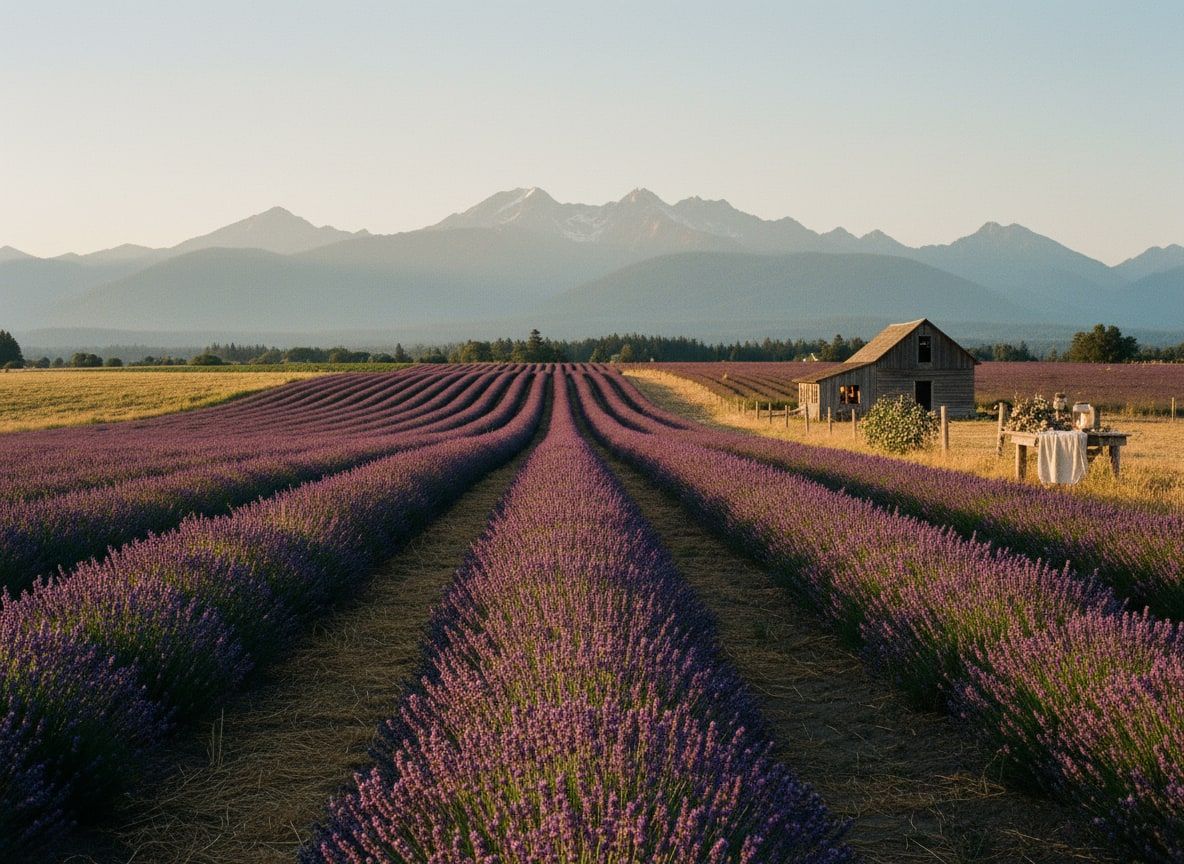
This is the one. Roughly late June through September, the Peninsula settles into its dry season, and it is genuinely, reliably good. Plenty of mornings still start soft and grey off the Strait — that’s the marine layer — and then burn back to blue by late morning and hold all afternoon. It’s why we’ll often set a summer ceremony for the afternoon and let the morning do whatever it wants first. It’s when the lavender’s up out in the valley and the whole place looks like the reason people move here. If you want the best odds for an outdoor date, this is where we point you, every single time.
That doesn’t mean we stop watching the sky. It means the odds are finally on your side, and we build the day to spend them well — the long light, the late sunsets, the plain fact that dinner outdoors in August out here is about as good as an evening gets anywhere.
October — October is October
We love October on the Peninsula. It’s also exactly where the honest part lives.
By October the dry window is closing. The marine air moves back in for good, the first real systems start lining up off the coast, and any given weekend can break either way. Some Octobers stay bright and open well past the middle of the month. Some turn on a dime and don’t turn back. We’ve watched both happen, more than once. So when someone wants an October date — and people do, it’s a beautiful month here — we say yes. We just say it with a backup already drawn up, not sketched on the back of something.
We build the backup either way
Every outdoor date we take gets a weather plan. Every one — even in the dead middle of the dry window, because “unlikely” and “impossible” are not the same word, and a wedding doesn’t get a make-up Saturday.
A backup is real money, so we name it out loud early. A tent big enough for a hundred guests is a line in your budget, not a footnote, and we’d rather you weigh it with a clear head in the spring than scramble for one the week of. If your date lands in the safe stretch, maybe you carry the tent as insurance you’ll probably never unroll. If it lands in the shoulder, maybe you commit to it up front. Either way you’ll see the real number, and you’ll know exactly why it’s there.
That’s the honest heart of this whole piece. We’re not selling you a Blue Hole where it never rains — it rains, we live here, we own good boots. We’re telling you the rain shadow is real, the dry window is real, and a Sequim summer hands you odds you will not find in almost any other outdoor spot in western Washington.
So — yes. You can actually do this here. Whether you’re standing up in Sequim, down in Dungeness, or out toward Joyce, tell us your date and we’ll tell you straight what kind of stretch it falls in, and exactly what we’d have standing behind it, just in case.